Dear reader,
The news is always delayed, naturally delayed, I suppose. Newsworthy events happen all the time, everywhere; a lot of horrible things, but certainly there’s good being done, too. Regardless, it’s only "news" to you if you haven’t been there to witness it. News bridges the gap between the witness and the uninitiated. “Man bites dog” is valid only if you’re watching it on your phone. Hence news—i.e., the message, the signal, the code—must travel a distance to be received by the uninvolved. The whole idea of news, one might say, is therefore structured by distance and delay as a precondition.
If you think about artistic display as news, the artistic subject discovers something worth sharing and takes it upon themself to bring the work into a space for consideration. This raises questions about what actually travels from the artist to the viewer. [Vers: That’s a hard one!] Certainly, it’s not as straightforward as reporting on the events of the day. Art is more boring in a sense; because it doesn’t intend to sell you a straight forward story (in most cases), it’s disarmed at the very first second. It’s artifice by all accounts, even if the artistic discourse accompanying a work is entrenched in real-life events. The work cannot retain a solid grip on the facts because its delay is much more pronounced than that of—for example (I wanted to write radio news and date myself, but I refuse!)—TikTok news. Pertinent news gets old quickly, good art, on the other hand, ages gracefully.
Does it make sense to speak in terms of communication when it comes to artistic production and display? To answer my own question: well, yes and no. I reckon most artists will recoil at the idea of their work carrying “a message,” which is an understandable response to a reductive claim of what art should be doing. BUT, at the same time, it is grazing something that artists nowadays seem to neglect and leave unaddressed: namely, their responsibility to the audience. Not in a strictly didactic or political sense, nor in the sense of being indebted to a supportive viewership, I'm reffering to responsibility to the viewer in the sense that a work is conceived in intersubjectivity.
There's a prevalent notion in artistic discourse (here I mean discourse made by artists) that artists would have made what they made no matter if it were intended for viewership or not. I doubt it. Sure, you’re doing your thing in your studio, eyes evaded, but you can’t hide forever and still be perceived as an artist, and artists know this instinctively. To make art is not a private affair; whatever goes on in the confines of the artist’s chamber must, in however small an amount, find its way outside to be called art, be reconfigured during presentation, and be engaged with, in however small an amount, by a public. Exhibitions and art at large exist, necessarily, at the crossroads of private and public.
Having concluded their aesthetic experiment, the artist—by putting the work on display—grants the viewer a thing to relate to. The news being delivered isn’t primarily about the artist's life; it's a dwelling place for the viewer's life. The news, in this case, gets misreported by every single viewer, that's obviously by design. At this stage art becomes interesting. There’s a strange tension in art’s fundamental tenet of exploring whatever the artistic subject deems important and the framework of exhibiting, which is more or less a negotiation with the public. One could think of exhibiting as an act of hosting.
From here, it’s easy to make the case that artists should be good hosts and consider what this might entail. “Artist as host” structures the notion of art through display and, consequently, around the presence and perception of the guest, rather than claiming artists as the sole arbiters of their work. In an art world that still holds on to the remnants of “artist as genius” for dear life—where egos are bolstered and staged unashamedly front and center—shifting the gaze outward and contemplating the viewer’s desires might not be a bad idea, if we’re interested in exploring paths other than “artist as brand.” Part of this will have to wrestle with how we might reconfigure the aforementioned delay in art to be more accommodating of viewership. This doesn’t mean producing art which is more accessible or caters to some demographic, although I wonder what art specifically for physicians might look like. Accommodation can only come in the form of awareness during the artistic process. Whatever you do in your own home—the inner architecture of your life, the meals you cook—remours yours. When guests arrive, you don’t go out and buy a new sofa or overhaul your palate, you just tidy up. You get the nice table cloth out and make sure the house is vacuumed. In the transition from studio to exhibition space, these same hospitable gestures should be taken into consideration in the decision making leading up to the display of art. To simplify: What I’m saying boils down to “be less selfish when you exhibit.”
Best,
Lovis
Haus u r
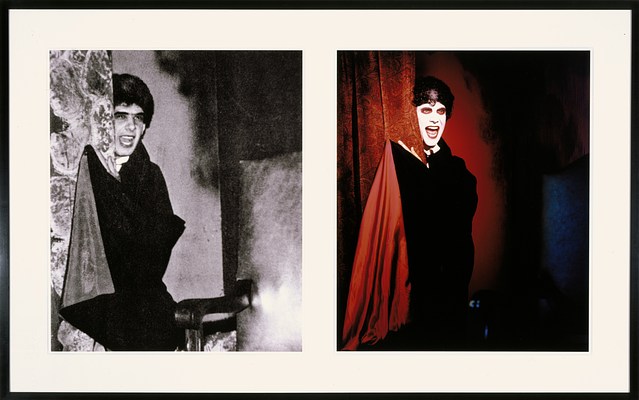
Take Mike Kelley’s mimetic reflex: that primal urge to reproduce, eros acting as art’s heartbeat. Kelley’s compulsion to copy what is out there and what constitutes "you" is not a Pygmalion-type fantasy, (in fact, not a fantasy at all, because fantasy is perfect in nature) but a yearning to undergo transformation through repetition. How does it feel to obstain from the hard-wired desire to hold on to the ideal, to one's self essentially. Artists might have a lot to teach us in that regard. Looking at some of her later works, I wonder if Sturtevant let go of the perfect copy, too? Kelley lets a kind of humility settle in the copy, an admission to the paradoxes of mimesis, an acceptance of the impossibility of the copy, and dares a step beyond language (the copy being the foundation for any language system). The truth of the copy, the truth of reproduction in general lies in the moment of madness, in the blackout, in the failure to satiate the source. To make a "perfect" copy then means to abandon the copy first and foremost. The artist must forgive and forget themself. Compare that to the average tourist. The tourist’s search for mistakes in Do Ho Suh's work follows from their insistence on the copy as a framework of perception; what guides them is a perverse form of mimesis. Here the imperfect is simply a negative signifier for the mirror image, the reproduction of the self. It is the imperfection, the faulty representation, that empowers them. It assures them of their place as consumers, as the one's in charge and the one's who's image should be perfect; they own the museum. This is not an insinuation, but a conceptual definition. They march through the frottage, hunting for a rubbed-off detail or a sign of laziness. In their eyes, art is effort on display. The tourist as the crowned consumer, the artist as the supplier. They are desperate to believe art is for them and not just a conspiracy of the highest order. Travel further, tourist! Visit Haus u r.
The Frederson-Altmann Phenomenon
Vers began fervently collecting empty aluminum beverage cans in their bedroom after having read about something called the Frederson-Altmann phenomenon, where exposure to a large quantity of similar objects causes a person to spontaneously recall imagined variations of them. There is reason to believe that this mnemonic illusion is related to déjà-vu.
What Vers could articulate, although hesitantly, was an interest in producing an object that did not yet exist but might begin to insist on its existence through sheer repetition. The phenomenon, as Vers understood it, promised precisely this. If exposed to enough similar cans, the brain would begin to remember a can that had never been there. Vers did not understand the phantom as a hallucination, but as a future entity calling itself into material form. The plan, if it can be called that, was to wait for this imagined can to emerge and then to treat it as real. To fabricate it, or to search for it, or simply to prove that it had always already existed. The idea followed Vers’s conviction that, “If you have two things, the in-between always generates a third.”
Why aluminum cans? There was, at first, an ethical alibi, they admit. Aluminum, after all, is recyclable. The thought of working with discarded cans carried the modest glow of ecological virtue — a way of doing something good while doing something weird. It seemed efficient to transform waste into research material. Vers did not yet know that virtually every aluminum can contains a thin plastic liner to prevent the liquid from reacting with the metal. The sustainability and “closed loop” of recycling aluminum cans has significant asterisks. So much for eco-friendly asceticism.
It wasn't long after Vers’s commitment that their room was filled with cans, placed in tight grids on the floor and stacked as high as gravity would allow, making most corners and furniture inaccessible. Cans arrived in bags, most often carrying a printed alcoholic percentage on their surface. There was a very particular order to the placement of the cans, so it seemed, on which Vers refuses to elaborate.
Vers caught on that most can that they could come across originate from a handful of manufacturers, that adhere to the same standard which made all drink containers easily be organisable by volume, dimension, and shape, from 190ml to 500 ml, from slim to thick, from short to tall. We imagine this influenced the order of the cans. Or perhaps they ordered them by brands or chronology of their find. But most likely, as Roelien believes, the spatial organization was a recursive system, meaning the rules for what should go where developed in the process of collecting the cans, and must have been revised once new elements were introduced. But who knows?
Vers’s room began to conjure a sweetish scent which is distinct to aluminum (according to Vers) which would seep into their clothes. It should be noted that while all cans previously contained liquids and were collected from the streets or fished out of trash bins, and although Vers’s confused compulsive behaviours led to welcome the trash that only happened after rinsing the containers thoroughly as to remove any undesirable residues. If the cans were crushed, Vers would carefully bend them back into their cylindrical shapes. Only a shoulder wide path from the door to the bed, and from the bed to their closet met their most basic needs. Vers shut off from the world for about three months to hoard cans (or that’s at least how it felt for the rest of the crew).
Vers would on a daily basis go through as many of the branded cans as their free time allowed and inspect their labels, idiosyncratic dents and kinks, attempting to imprint these singularities into their mind. They noticed that due to certain structural features of these cans there are only so many ways a can be crushed, meaning only so many types of indentations that can exist. As the mountains grew, Vers’s spacial memory adapted to the peculiar environment and habit of organizing the cans systematically and slowly gave way to a mental map of these ranges. Errors were frequent at first, but the more Vers entrenched themself in the cans, the more meaningful each one’s designated spot felt.
The project stopped once Vers started seeing D. It was easier to abandon the project, to clear physical and mental space, than attempt explaining away what could read as a red flag. Although Vers achieved extreme familiarity with the cans, they did not register any spontaneous imagery during the day. However, according to their understanding, the Frederson-Altmann phenomenon only manifests once the memory of the set of objects begins to fade. Vers maintains that the can’s manifestation is inevitable; it is simply a matter of time before it makes itself known. Therefore the experiment remains in progress.
Re: Dear reader
Dear Lovis,
The metaphor of the artist as host is generous. It imagines exhibiting as a shared space rather than a stage. Your argument for artistic display turns toward the ethics of encounter. That shift is not insignificant. And yet, I wonder whether hospitality is the right metaphor. You describe art as a form of news, delayed but still traveling, structured by distance. I follow you there. But not all news seeks to be received comfortably. Some news does not bridge the gap between witness and outsider, it exposes the gap. It reveals that distance cannot be so easily overcome.
When you speak of the artist’s responsibility to the audience, I hesitate. Responsibility can be a productive word, but it can also easily become a constraint. To whom, precisely, is the artist responsible? To the attentive viewer? The distracted one? The institutional framework that makes exhibition possible? Or to the work itself? You suggest that artists would not make what they make if no one were ever to see it. Perhaps. But it does not follow that the work must anticipate its audience in order to justify itself. The studio may not be entirely private, but it is a space where something can unfold without immediately negotiating its legibility. If the artist begins tidying too early — even metaphorically — something fragile might never emerge.
Tidying, laying out the tablecloth, vacuuming the floor — these are acts of care, certainly. But they are also acts of smoothing. And not all works benefit from being smoothed. Some require rough edges. Some operate precisely by refusing comfort. Here your analogy loses its appeal to me. There is a risk that hospitality becomes a new orthodoxy. If the genius myth centered the artist too aggressively, the host metaphor might risk centering the viewer too eagerly. Both positions remain bound to the same economy of expectation. In one, the viewer admires; in the other, the viewer is accommodated. But what of the viewer who must work? Who must negotiate opacity? Who must endure uncertainty?
If we are to speak of selfishness, then perhaps we should distinguish between types. There is the selfishness of ego — the insistence on being seen, centered, branded. That is wearying. But there is also the selfishness of attention — the refusal to dilute a question for the sake of reception. The refusal to preemptively accommodate. That kind of selfishness may be less about self-protection and more about protecting the integrity of an inquiry. In that sense, perhaps exhibiting is not hosting but exposure. The artist exposes something unfinished, and the viewer exposes their own interpretive habits in return. Neither owes the other comfort. Actually they share a certain kind of risk in their encounter.
So while I admire your call to awareness, I would hesitate to frame the matter as “be less selfish.” Sometimes the most generous gesture an artist can make is to trust the viewer enough not to cushion the encounter. A little dirt never hurt anyone.
Sincerely,
Roelien
Session
[...]
We met that evening as Soapbox, or under its remains. Lovis spoke about a dream he had in 2022, a dream that, according to him, changed his life. He recounted the experience as a conceptual framework, offering it as a guiding light for our next chapter. Whatever it was, it could not have been too important, if the rest of us cannot properly recall it for our agenda letter.
[Lovis here and I must interject! I doubt any dream would seem as pertinent to a person who did not witness it as to the person who actually dreamt it and meaning is produced on an extremely subjective level so conveying it in words cannot do the experience justice which pertains to the usual issue of mediation, how can I make you feel what I felt?, it is a lost bet! Beware of the dreams of others and my dream was life-changing and you do not have to experience my dream to be in its sphere of influence because any shift in my being will eventually alter the course of yours if we keep working together. I dreamt I was a teenager again bent over homework and I revisit unfinished problems in sleep the way some people revisit childhood homes and there is comfort in the solvable so in the dream I became tired and decided to go to bed and I believed I was descending into deeper sleep and then I awoke in reality. The violence was in the mismatch and I had not known I was dreaming and I had intended to sleep further and the continuity was seamless until it wasn’t and when I opened my eyes I was in my real bedroom and not aligned with it. I tried to swing my legs to the right side of the bed where the floor should have been and met a wall and the imagined bed had transformed and I felt strange and this feeling had nothing to do with the Proustian tearing through the membrane of sleep inertia! It occurred to me as a bodily certainty that attention and forgetting are the toggles for reality and in the dream I had neglected the possibility that I was dreaming and so it hardened into the world and in waking I could no longer fully neglect the suspicion that this too might be a layer whose floor could slide to the wrong side of the bed and I wasn’t the ruler of my domain anymore. You keep asking what the dream was about and it was about authority and about which level gets to claim the status of base reality and I understood standing there on the mattress, yes I stood up arms lifted as if stabilizing myself on a boat!, that I had no reliable mechanism for determining which layer I occupied. My girlfriend woke and asked what I was doing and I tried to explain and as I spoke the feeling intensified as if narration were feeding it and she said she would like to go back to sleep because she was already certain of the floor and I’m telling you this is important and something in me lost weight that morning.]
Following that morning of his life-changing dream, a granular shift took hold of Lovis, as he explained. He did not renounce his life or declare an allegiance to chaos; instead, he simply ceased to finish things in the usual manner [...]
And so that final meeting didn't really feel like an ending than a misalignment. We were still there, seated around the table, but the room had shifted a few degrees to the left. We kept trying to swing our legs to the familiar side, but encountered a wall.